
There is an old science fiction movie called Forbidden Planet. It tells the story of an advanced civilization whose brilliance became its undoing. They possessed astonishing knowledge, remarkable technology, and power beyond imagination. Yet none of those things could save them.
Their greatest enemy did not arrive in a spaceship. It did not come from another world. It came from within.
The movie called them the monsters of the id—the unseen fears, desires, assumptions, and distortions that quietly took on a life of their own until they became destructive, annihilating their civilization. Whether or not we embrace the psychology behind the story is almost beside the point; its premise still holds.
Sometimes the greatest danger is not what stands before us, but what quietly shapes the way we see.
Have you ever noticed how people can experience the very same event and come away believing entirely different stories? One remembers kindness; another remembers rejection. One sees hope; another carries disappointment. The event may be identical, yet the story we tell ourselves slowly becomes the world we begin to inhabit.
That is the subtle power of unseen things. Not because they are true. But because they become familiar. As I thought about that, another realization quietly surfaced.
We sometimes do something similar with God. Not that we create God—He is who He has always been—but we can create images of Him that He never intended us to carry.
Those images are rarely formed in a single moment. They are painted one brushstroke at a time—through disappointment, painful experiences, careless words, religious traditions, unanswered prayers, or assumptions we absorb without ever realizing they have become part of us. Eventually, the portrait becomes so familiar that we stop asking whether it actually resembles the One we claim to know.
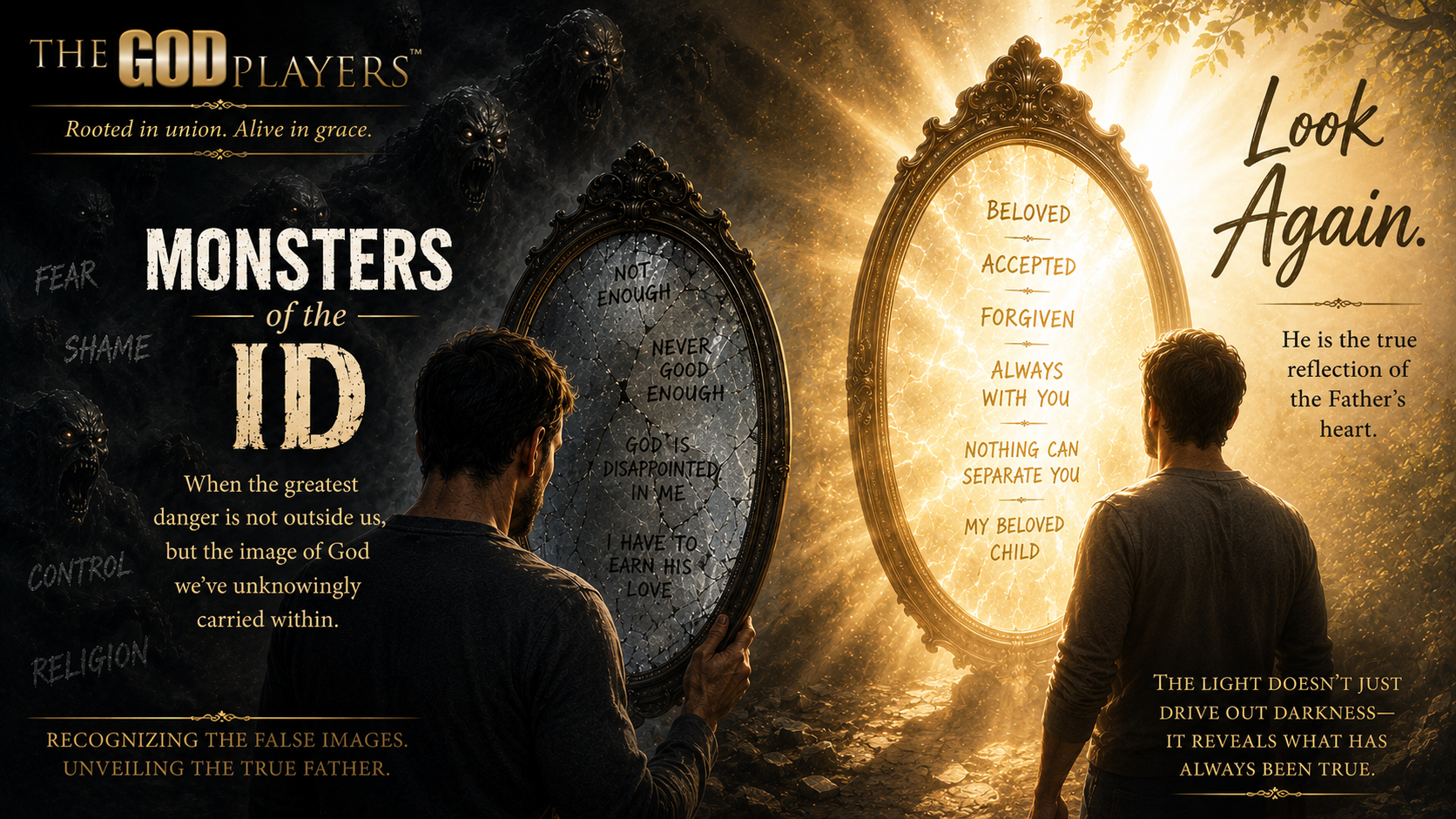
If we’re honest, most of us have stood before those portraits. Perhaps we have prayed as though God needed convincing. Perhaps we have apologized for the same failure because we quietly assumed He had not really forgiven us. Perhaps we have carried the exhausting weight of trying to earn a love that was never waiting to be earned. Perhaps we have imagined Him watching us with folded arms rather than open ones.
The remarkable thing about false portraits is not that they are convincing. It is that they become invisible. We simply assume they are God.
Until Jesus comes into view.
He welcomes children who have nothing to offer. He shares meals with those respectable religion keeps at a distance. He touches what everyone else refuses to touch. He restores dignity before demanding change. He forgives while the accusations are still echoing.
He reveals a Father who runs toward His children instead of waiting for them to prove they deserve to come home.
Without ever saying, “Let Me explain the Father,” Jesus simply lives before us until another portrait begins to emerge. One image quietly replaces another. Perhaps that is where the real monsters lose their power—not because they have been defeated in some great battle, but because they have finally been exposed to the light.
Fear whispers that God is disappointed. Shame insists we have wandered too far. Pride tells us acceptance must be earned.
Religion can even place beautiful frames around those portraits until they seem sacred. Yet when they are placed beside Jesus, something begins to happen. They no longer resemble the Father He came to reveal.
Paul speaks of the renewing of our minds. For years I assumed that meant simply learning better doctrines. While sound doctrine certainly matters, I have come to wonder whether something even deeper is taking place.
What if the Spirit is patiently healing our imagination? What if He is restoring the eyes of our heart until we begin to recognize the Father as He has always been? That kind of healing can be unsettling. Sometimes we discover that what we have defended for years was never God Himself, but only a portrait we inherited.
Yet there is no shame in laying down a false picture. Only freedom.
John tells us that no one has ever seen God, but the Son has made Him known. Perhaps that is more than a theological statement. Perhaps it is an invitation.
An invitation to linger a little longer with Jesus—to notice how He responds to failure, to watch where He walks, to listen to whom He welcomes, and to discover the Father’s heart reflected in every word, every embrace, every act of mercy.
And somewhere along the way, something unexpected begins to happen. We stop trying to convince ourselves that God is good. We begin to recognize that He always has been. And with that recognition comes something we were never able to manufacture for ourselves.
Peace.
When the Father’s heart comes into view, so does peace. Not because every storm has passed, every question has been answered, or life has suddenly become easy.
Jesus slept in the storm long before the wind became still. His peace flowed from complete rest in the Father’s love. As the false portraits quietly fade and the face of the Father becomes clearer in Christ, we discover that peace is not something we achieve.
It is something we awaken to. The storm may still rage. Yet something within us grows strangely still. Not because every mystery has been solved, but because we have come to trust the heart of the One who has been with us all along.
Perhaps that is what peace looks like. Not the absence of the storm…
But the presence of the Father, finally seen. The greatest freedom is not discovering a new God. It is finally seeing the One who has been with us all along.
