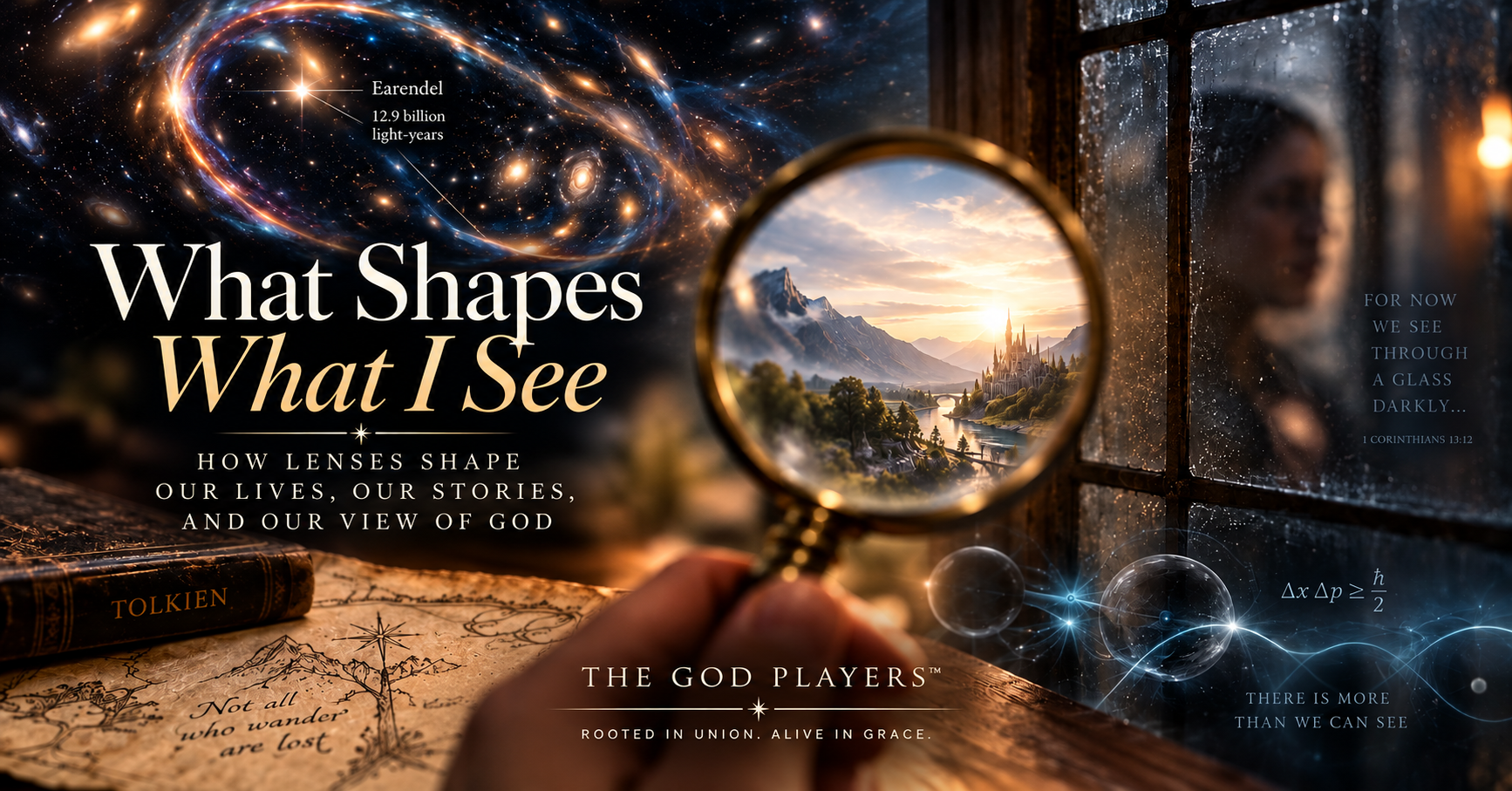
There is a star so far away that, under ordinary circumstances, we should never have been able to see it. Its name is Earendel.
The light reaching us from Earendel began its journey when the universe was still very young. The star lies in a galaxy billions of light-years away, far beyond the distance at which astronomers would normally expect to distinguish a single star. And yet we can see it.
Not because Earendel suddenly became brighter or moved closer, but because something entered the path of its light and, without any awareness of the part it played, became the means by which the unseen came into view.
A massive galaxy cluster lies along our line of sight, and its enormous gravity bends the fabric of spacetime, altering the path and magnifying the light traveling through it. Earendel happens to be extraordinarily well aligned with that gravitational lens, bringing into view a star that would otherwise remain beyond our sight. Astronomers have to understand what the lens is doing to understand what they are seeing.
Something else caught my attention—the star’s name. Earendel sounded familiar. I remembered that J.R.R. Tolkien had once encountered an ancient Old English form of the same name, Éarendel, long before it was given to this distant star.
Tolkien is well known for his gift of writing within the world of fantasy. He believed people became so accustomed to what surrounded them that they ceased really looking at it. He used fantasy to let us encounter familiar things as though we were seeing them again. He called it Recovery.
The stories we have been taught, our relationships, and our experiences all become part of the lens through which we see. Some may obscure, others may illuminate, and some may simply give us another piece of something we are still learning to see. What we see matters because we live in response to what we believe we see.
The lens does not change reality. But it can profoundly change what reality looks like.
Jesus encountered people who could see and yet did not perceive, who could hear and yet did not understand. Paul prayed that the eyes of the heart would be enlightened and wrote of beholding with unveiled faces.
Information can tell us something we did not know. Recognition can cause us to look at something we may have known for years and suddenly say, There it is.
Truth does not begin when we recognize it. Sometimes recognition is simply the moment we finally see what was there all along.
Philip had walked with Jesus. He had listened to Him, watched Him heal, and heard Him speak about the Father. And still Philip said, “Lord, show us the Father.” (John 14:8)
Jesus answered him: “Whoever has seen me has seen the Father.” (John 14:9)
What was obscuring Philip's ability to see and understand that he needed to ask the question? What had shaped his picture of God? Jesus's response gave him a lens through which everything could come into focus.
Look at Me.
Suddenly all those things that have shaped our picture of God—Scripture we have read, things we were taught, experiences we have had, conclusions we have reached, fears we have carried—have somewhere to land.
If the Father we imagine does not look like Jesus, perhaps we should look again. If we imagine a God reluctant to love until something changes His mind, look again. If shame tells us our worst moment has become our identity, look again. If fear tells us darkness is the whole sky, look again. If religion has taught us that God is somewhere far away waiting for us to find the correct path back to Him, perhaps we should look again at the One who came looking for us.
We have moments when something we have heard a hundred times suddenly becomes something we know. Something ordinary becomes luminous. A person helps us see what we had overlooked. A familiar passage of Scripture seems to have been waiting for us to notice what was there. And like Tolkien's Recovery, a story can change our angle.
We do not suddenly see everything. We do not always immediately and fully comprehend everything we see. But sometimes we see enough to want to keep looking.
Which brings us back to a tiny point of light unimaginably far away.
Earendel did not begin shining when we discovered it. For an incomprehensible length of time, its light had already been traveling toward us. Then came an extraordinary alignment: a star, a massive galaxy cluster, gravity bending spacetime, light traveling through it, and human beings looking into the darkness.
Something previously beyond our sight came into view.
Scripture calls us again and again to have eyes that see. Science reminds us that even the universe contains realities that can remain beyond our sight until something brings them into view. And grace keeps inviting us to look again.
The question is not whether there is more to see, but whether we are willing to discover what has shaped the way we see.
Because the light is already shining.