
Some questions don’t seek answers so much as they open doors into mystery, beauty, and the heart of God. This one is like that: Why did Jesus have to come as the Son of God, and not just as God in the flesh? And why did He have to be born of a virgin?
These aren’t theological puzzles to solve. They are sacred threads woven into a love story that stretches from before time, where all is eternal, into the womb of a woman. Journeying from a cross to an empty grave, from heaven’s throne to the inside of our heart.
The Son: Not Rank, But Relationship
Jesus didn’t come to us in sheer authority. He came in intimacy. The title “Son of God” isn’t about hierarchy; it’s about belonging. It’s about revealing the eternal relationship between Father, Son, and Holy Spirit.
If Jesus had shown up as God in power, we might have obeyed, but we would have missed the invitation to belong. He came as the Son so we could see what it means to be children of God and family.
To call Jesus Son is to say: This is what love looks like in skin. This is what the Father’s heart beats like. Come closer. “He who has seen Me has seen the Father…” (John 14:9).
The Son Who Became Like Us
Jesus became flesh, not just to visit but to become what we are. As Paul wrote, “He is the firstborn among many brothers and sisters…” (Romans 8:29). He shows us our true humanity, what it looks like to live in full union with God. He didn’t come just to save us from something. He came to awaken us to something. To the truth that we have always been loved, included, and one with Him.
What Is Spirit? What Is Flesh?
Scripture tells us, plainly and beautifully: “God is Spirit…” (John 4:24). But what does that mean?
In the biblical languages, the word for spirit, ruach in Hebrew and pneuma in Greek, means breath, wind, or life-force. It is not vapor or ghost-like imagery. Rather, it speaks of something real, powerful, and unseen. God as Spirit means:
- Not made of matter, not bound by bone or blood
- Without decay, division, or death
- Life itself, uncreated and eternal
As Basil the Great once said: “God is simple essence, without parts or body, eternal and incorruptible.”
In contrast, humans were formed from dust and animated by God’s breath (Genesis 2:7). That breath didn’t make us spirit; it made us living flesh, pulsing with blood. Scripture says, “The life of the flesh is in the blood…” (Leviticus 17:11).
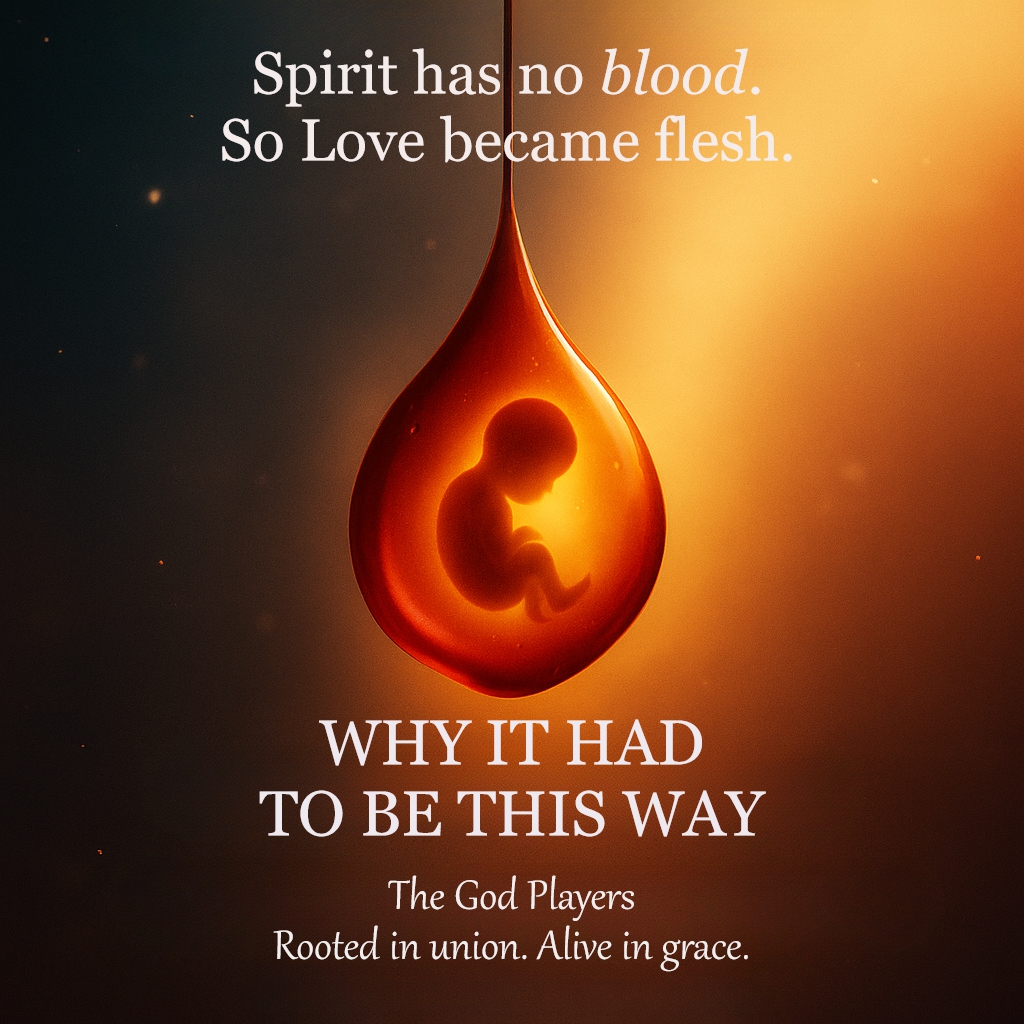
From the beginning, blood carried the symbol of life, and it became the sacred seal of every covenant. So yes: Spirit has no blood. But God made us as beings of blood, knowing that if union were to be fully restored, love would have to take on blood to meet us there.
As Irenaeus wrote: “The Word of God, our Lord Jesus Christ, through His transcendent love, became what we are, that He might bring us to be even what He is Himself.”
And Athanasius: “The incorporeal and incorruptible Word entered our world… so that by His death all might be saved.”
The blood of Christ wasn’t necessary because God required violence; it was necessary because healing had to come from within the system of broken flesh. Redemption had to meet us where we were: in the body, with blood.
Spirit has no blood. But Love chose to bleed.
This is where the story becomes physical. Spirit has no blood. But from the moment of the Fall in the Garden of Eden, God chose to speak through covenants sealed with blood. “Without the shedding of blood, there is no forgiveness…” ( Hebrews 9:22). Jesus came not just to teach us or inspire us. He came knowing He would bleed. He would enter death itself, and from inside it, destroy its power.
God had to become mortal, killable, touchable. So He put on flesh. Not as an illusion, but as real skin, cells, nerves, and blood. He didn’t avoid pain. He entered it. And in doing so, sanctified every tear you’ve ever cried. “The Church of God, which He bought with His own blood…” (Acts 20:28).
And the mystery deepens: this wasn’t done by the Son alone. The Father sent. The Spirit overshadowed. The Son entered. This was the Trinity’s united act of redemption, not through wrath, but through shared love.
Why a Virgin?
Because salvation doesn’t come through human effort. It never did. The virgin conception was the signal: This is not of man’s making.
- Not Joseph’s seed.
- Not Adam’s inheritance.
- Not earned.
- Not possible.
Mary’s womb became the new Garden, where heaven’s Seed was planted by the Holy Spirit, not by striving, but by surrender. “Be it unto me according to your word…” (Luke 1:38). Mary became the first to receive Christ not just in body, but in surrender. She is the echo of every “yes” that brings Christ into the world again.
An inauguration into a new creation was accomplished through the virgin birth because it bypassed the inherited corruption of the Fall. It was not just a miracle. It was a prophetic sign: The old has gone. The new has come.
The Humanity of God: Forever Changed
Here is the staggering truth we sometimes overlook: Jesus did not cast off or discard His humanity when He ascended. The incarnation wasn’t a temporary mission. It was an eternal union. When Christ rose and ascended, He rose not as a disembodied spirit, but as a glorified human, still bearing wounds, still carrying flesh. This means that the uncreated God chose to permanently unite Himself to creation.
“There is one God and one mediator between God and mankind, the man Christ Jesus…” (1 Timothy 2:5). The Godhead has now welcomed humanity into itself, not as a costume worn for 33 years, but as part of divine self-giving love forever.
This is why Christ is called the firstborn from the dead (Colossians 1:18). He is not just our Savior—He is the new humanity, enthroned. As Gregory Nazianzen wrote: “He remains what He was; what He was not, He assumed, yet not ceasing to be what He was.” The Son remains divine—and yet fully human. In Christ, God has made room for us in God’s own being.
What It All Means
Every detail mattered.
- Son – so we could see the heart of the Father.
- Flesh – so our humanity could be healed from within.
- Blood – so the covenant of grace could be eternally sealed.
- Virgin womb – so we’d know this was all God’s doing, not ours.
None of it was random. None of it was optional. It had to be this way—because this is what love looks like when it takes on flesh and bone.
- Jesus came not just to save us, but to include us.
- His sonship reveals our place in the Father’s house.
- Blood was not spilled in wrath, but poured out in love.
- Mary’s yes echoes into our own: Let it be to me, too, Lord.
- This was never about rules or wrath, but about a God willing to bleed, be born, and become…for us.
It has to be this way because Love refused to remain untouched.
